Firmness is a felt property, not a quality certificate. Two products carrying the same label may respond differently, and two bodies can read one mattress in opposite ways.
Look for balance between support and pressure relief: the body should not sink without control, but shoulder and hip should not fight an unyielding surface all night.
Support and firmness are not synonyms
Support describes how the full system holds the body; firmness is the resistance felt near the surface. A forgiving comfort layer can sit above a stable core. Conversely, a hard surface can distribute pressure poorly.
Low, medium and high labels therefore offer only an initial comparison within a range. They are not standardised between manufacturers. Use them to compare nearby variants, not to infer health benefit, durability or quality.
Body weight and position change the result
A lighter person compresses the layers less and may experience as hard what a heavier sleeper calls balanced. A heavier body enters further and needs to assess whether support remains controlled, rather than automatically chasing the highest number.
Side sleeping needs room at shoulder and hip. Back sleeping benefits from continuity without uncontrolled pelvic drop. Front sleeping often puts more emphasis on pelvic control. If you rotate positions, focus on the one occupying most of the night and on ease of turning.
The base also decides
One mattress can respond differently on an upholstered platform or storage-divan lid. A tired base may create dips mistakenly blamed on the mattress. Judge the whole system and respect the manufacturer’s compatibility limits.
Height is another variable. A firm mattress on a tall base can either help or hinder standing depending on leg length. With reduced mobility, simulate sitting, secure foot placement and rising at home; lying comfort is only half the task.
How to validate it after delivery
Use your usual position and notice localised pressure, tension, turning effort and whether breathing remains easy. Partners should move separately and use their real space during the first nights.
For an online order, understand unpacking, home adaptation and return transport before paying. Keep packaging where the terms require it. A useful return policy is one you can explain before opening the mattress.
What the evidence adds — and what it cannot choose for you
A randomised trial of 313 adults with chronic non-specific low-back pain found better average outcomes on a medium-firm mattress than a firm one after 90 days. A later systematic review also placed medium-firm designs among those most consistently associated with comfort, sleep and alignment in the available studies. Neither paper makes “medium-firm” a universal prescription: brand scales are not equivalent, and your pressure, mobility and base still need checking.
Seek professional healthcare advice for persistent, severe or unexplained pain. Replacing a mattress is not a diagnosis or a treatment.
- Multicentre trial of mattress firmness and low-back pain — PubMed
- Systematic review of mattresses, pain and sleep quality — PMC
Keep refining
More options to compare
Choose by size, feel and available space. These options suit different needs.
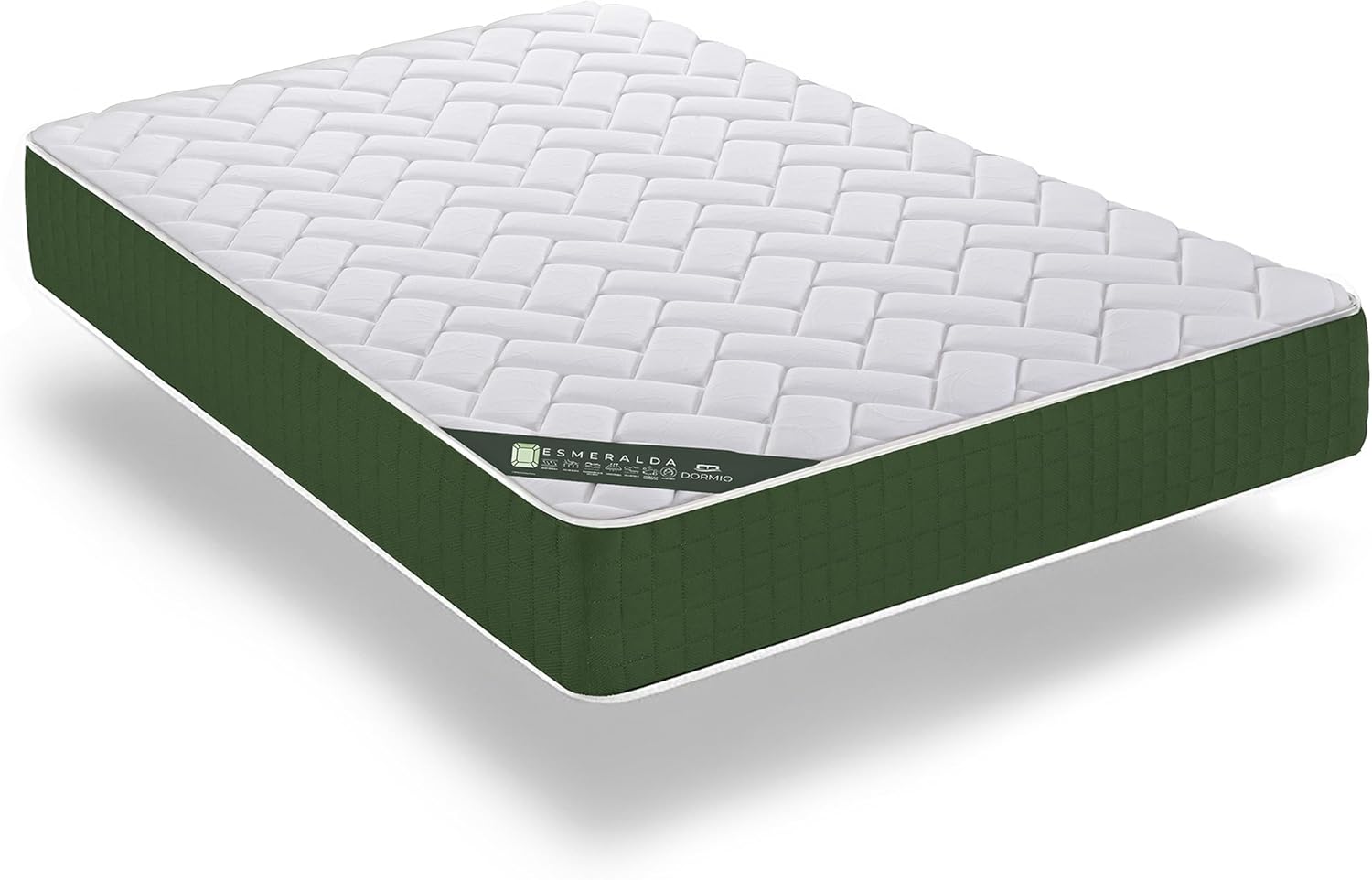
Dormio Esmeralda 90 × 190 × 21
A reversible memory-foam single mattress with adaptable comfort and a listing with a broad buyer history.
View on Amazon →
Todocama Airsoft 90 × 190 × 21
A medium-high firmness multilayer model in the exact single size, with an accessible price position and recent demand signals.
View on Amazon →
Cecotec Flow PureVital 1900 — 105 × 190
HR foam, memory foam and two usable sides in 105 × 190 for a firmer single bed.
View on Amazon →
DESCANSIN Magnum Sleep 150 × 190 × 30
A tall HR and memory-foam mattress with a firm feel, useful for comparing support and edge stability without springs.
View on Amazon →